

The African American Middle Class
Alarmingly Insufficient Assets
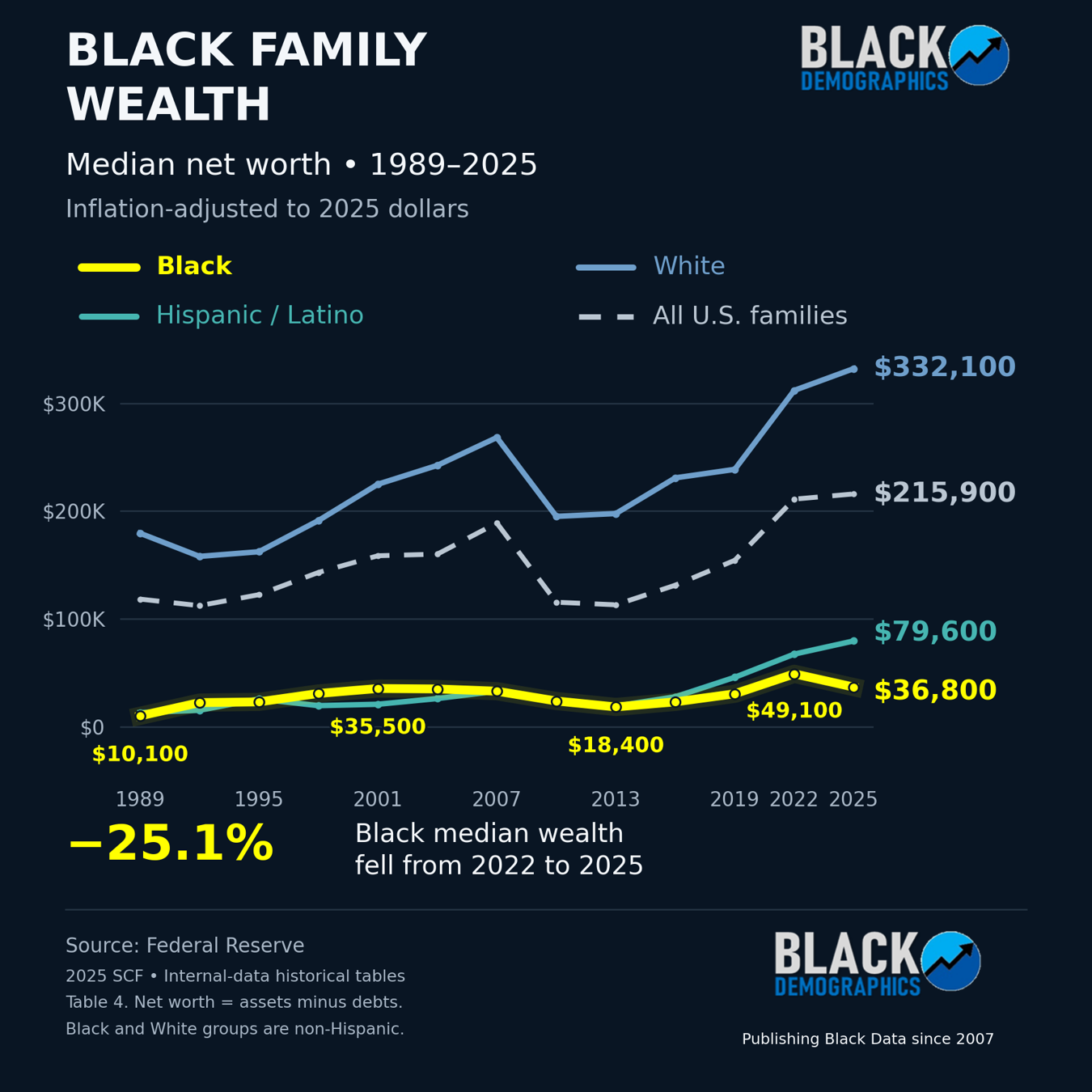
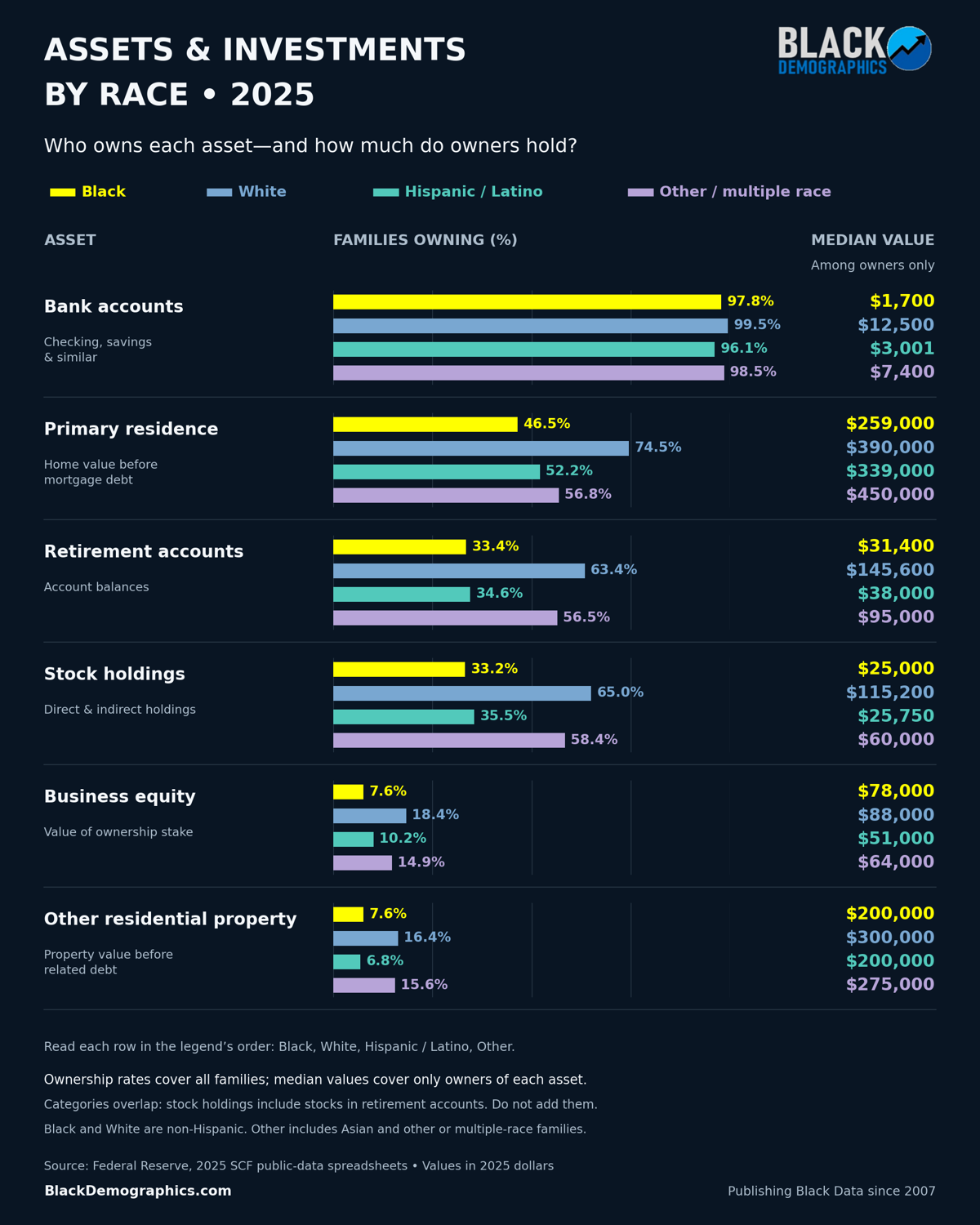
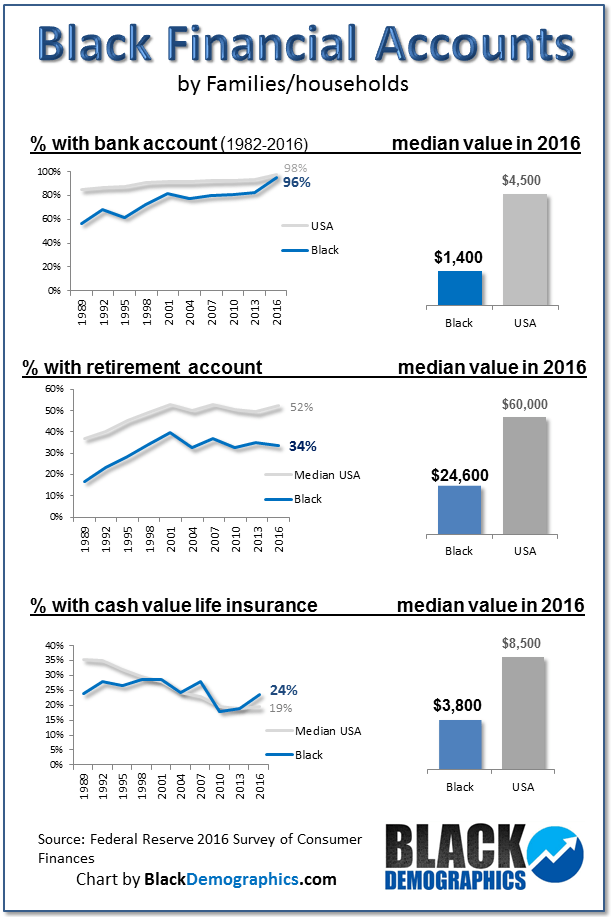
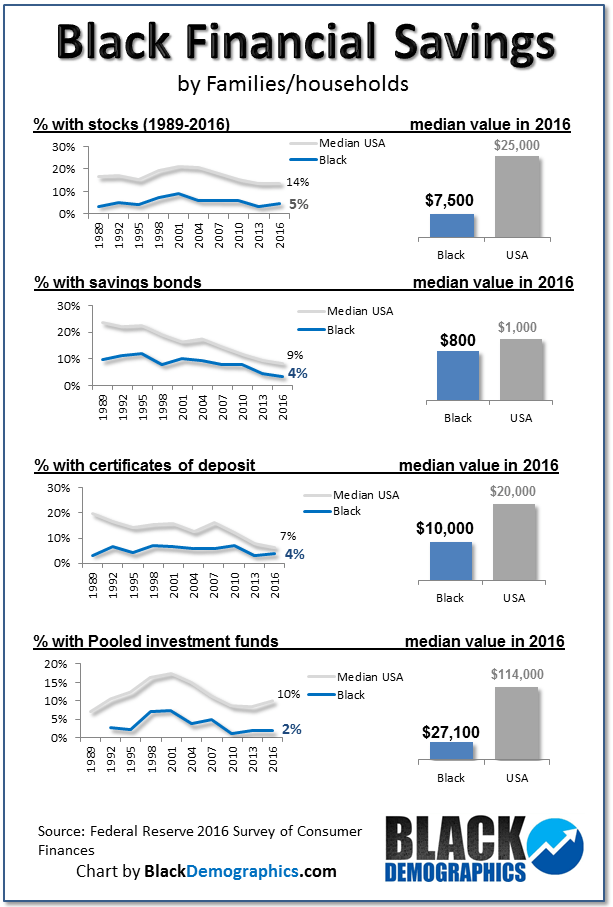
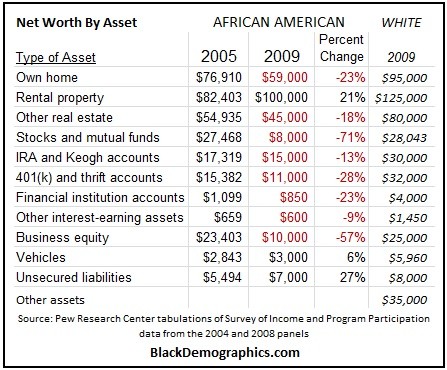
Sixty-eight percent of African-American middle-class households have no net financial assets whatsoever and live from paycheck to paycheck.
Only 2 percent of African-American middle-class families have enough net financial assets to meet three-quarters of their essential living expenses for nine months if their source of income disappeared. well below the already alarmingly low national average of 13 percent.
Even more alarming, 95 percent of African-American middleclass families do not have enough net assets to meet three-quarters of their essential living expenses for even three months if their source of income were to disappear. This figure is well above the national average among all middle-class families of 78 percent.
Inadequate Incomes to Meet Housing Expenses
Only 26 percent of African-American middle-class families spend less than 20 percent of their after-tax income on housing—below the national average of 40 percent.
Thirty-one percent of African-American middle-class families match the Department of Housing and Urban Development’s definition for housing burdened, spending 30 percent or more of their after-tax income on housing expenses. This falls well above the national average of 28 percent of all middle-class families.
Inadequate Incomes to Meet Essential Expenses
Thirty-six percent of African-American middle-class families are secure in being able to meet essential family needs because they have $25,000 or more left over after paying income taxes and meeting essential family needs each year, compared to the national average 34 percent.
Nineteen percent of African-American families are at risk of falling out of the middle class because they have less than $5,000 per year left over after paying for taxes and essential expenses, compared to the national average of 21 percent.
The African American Middle Class
There has been a Black middle class in America since before emancipation from slavery. However in those times it only consisted of very fair skinned blacks who were more accepted in the white communities and were allowed to work better jobs.
Although they were more accepted they were still segregated from whites and were also isolated and even scorned by the rest of the Black community. They developed their own institutions, businesses, and places of worship.
Some Black colleges even asked for photos with applications to keep from enrolling too many dark-skinned students.
Black Middle Class in Danger
The social glue that keeps families intact and financially prosperous is sometimes referred to as “stickiness". Major parts of the formula include good neighborhoods, property ownership, saving habits, marriage, health care, strong school expectations and inherited wealth.
However, due to a lack of one or many of these factors, the majority of African-American families who have entered the middle class are either borderline or at high risk of falling out of the middle class altogether.
A report by Demos and the Institute for Assets and Social Policy (IASP) at Brandeis University shows that only one in four African-American middle-class families in America are financially secure.
"Tremendous middle-class gains earned in schools, achieved on the job, and seen in paychecks are eroded by lack of assets, which seriously undermines the financial security of African-American middle class families.” The causes are complex and interlinked, but several bear closer scrutiny:
Family Structure
The biggest driver of rising income and living standards of American families is the two-paycheck family. Due to low marriage and high divorce rates, too few African-Americans benefit from that trend. And now that 70% of Black babies are born out of wedlock it looks like things will not change for the better anytime soon.
From 1974 to 2004, the median income fell 12% for Black men while rising 75% for the women. One partial explanation is that twice as many Black women as men graduate from college. Because a high-earning woman has little incentive to marry a low-earning man, Black families will continue to rely primarily one income.
Education
Some feel achieving middle class status is a guarantee that children will start achieving in school. However, studies of well-integrated, middle-class school districts, such as Shaker Heights outside Cleveland, show that many teachers and parents tent to have lower expectations of black students. Even in majority Black suburban school districts Black students (especially boys) grade significantly lower than white students of the same income level. Reasons for this are parallel to the explanation of why the Black middle class is in danger.
Thirty-two percent of African-American middle-class households meet the education threshold for economic security that at least one member of the household has a bachelor’s degree or higher. This falls well below the national middleclass average of 36 percent.
Thirty-four percent of African-American middle-class households are at high risk because neither the primary earner nor the spouse has any education beyond high school—well above the national middle-class average of 27 percent
Discrimination.
Blacks and whites have sharply different perceptions about the persistence of racial discrimination in U.S. society, Pew found. About two-thirds of blacks say blacks often or almost always face discrimination when applying for a job, renting an apartment or buying a house. By contrast, large majorities of whites believe blacks rarely face bias in these situations. Majorities of both races, however, believe that blacks who don't get ahead have mainly themselves, not discrimination, to blame.
In Queens, the median income among black households, nearing $52,000 a year, has surpassed that of whites in 2005, an analysis of new census data shows. No other county in the country with a population over 65,000 can make that claim. The gains among blacks in Queens, the city’s middle-class borough, were driven largely by the growth of two-parent families and the successes of immigrants from the West Indies. Many live in tidy homes in enclaves like Cambria Heights, Rosedale and Laurelton west of the border with Nassau County.
Prince George's County Executive Jack B. Johnson watches Special Assistant to the County Executive Ralph E. Moultrie being sworn-in. Prince George’s County just outside of Washington D.C. has the highest earning Black middle class community in the nation.
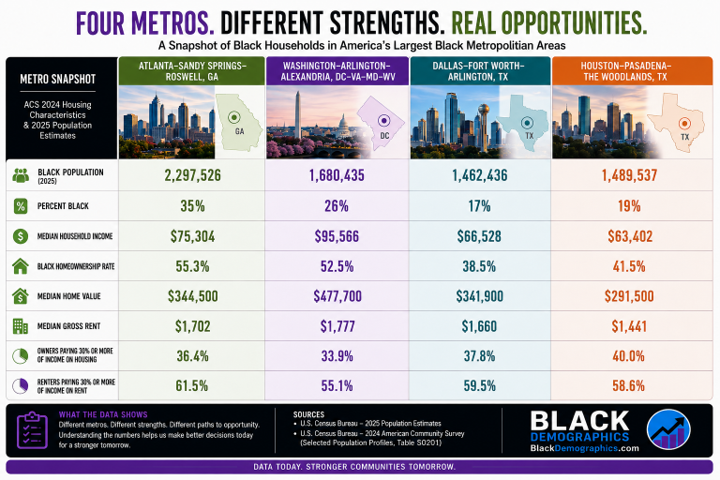
Mixed-use boom: DeKalb CEO Vernon Jones says some 1,600 new homes, restaurants and shops are opening around The Mall At Stonecrest in southeast DeKalb County, GA Americas second largest mclack middle class community.
Overall Economic Security
African-American families have more difficulty moving into the middle class, and the families that do are less secure and at higher risk of falling back out.
Only 26 percent of African-American middle-class families have the combination of assets, education, sufficient income, and health insurance to ensure middle-class financial security.
One in three (33 percent) are at high risk of falling out of the middle class. This is in sharp contrast to the middle class as a whole, where 31 percent are secure and 21 percent are at risk.

Downward Mobility
According to a report done by USA today on November 19, 2007 about the sons and daughters of the black middle class: 45% of black children from those families end up "near poor," Pew reported. The comparable number for white families is 16%.
Lack of Healthcare
Only 70 percent of African-American middle-class families have every household member covered by private or government health insurance, well below the middle-class average of 77 percent.
Thirty percent of African-American households are at high risk because at least one household member is not insured, both well above the national middle-class average of 23 percent.
Source: Dēmos: A Network for Ideas & Action
http://iasp.brandeis.edu/pdfs/byathreadlatino.pdf
Web site designed & administered by Akiim DeShay © 2007- 2009
Blueprint of Black America
Search BlackDemographics.com
This portion below was taken from the report: Dēmos: A Network for Ideas & Action
http://iasp.brandeis.edu/pdfs/byathreadlatino.pdf
Search BlackDemographics.com
Growth
Most of those who considered themselves middle-class were still confined to the inner city and lived among the working class and poor blacks. Things changed with the Civil Rights movement. Since the 60s the Black middle class has grown tremendously. African Americans have moved into more white collar jobs and are more educated than ever before. No longer isolated and identified by skin tone they integrated into white middle class neighborhoods and developed their own black middle class neighborhoods.
By the 1990s middle class Black America was well established as a separate community and was no longer forced to live with lower income Blacks. Communities such as South Dekalb (Atlanta), Prince George's County (DC/MD), and Baldwin Hills (Los Angeles) sprung up across the country and are still growing today
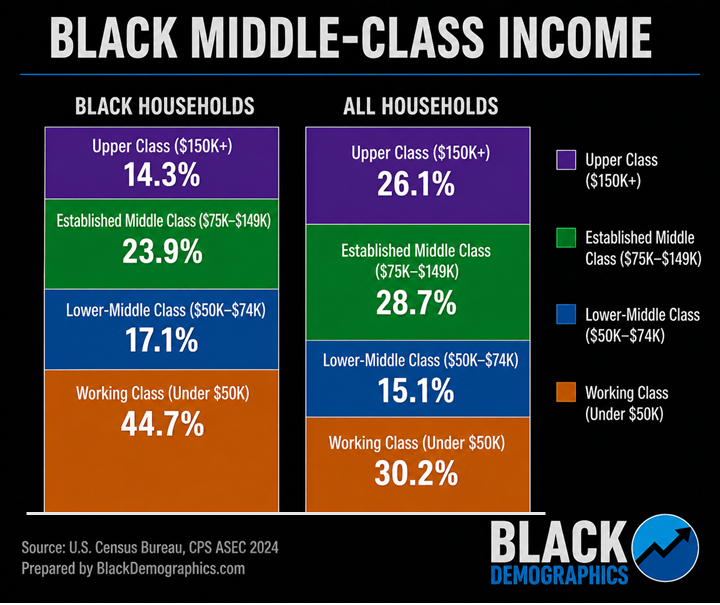
What is Middle Class: Income
There is no specific definition of what Middle Class is by name according to the U.S. Census Bureau or the Bureau of Labor Statistics. However, considering that middle class is above poverty, the nearest definition would be the 'median income'. Median Income “is the amount which divides the income distribution into two equal groups, ½ having income above median and ½ having income below the median”. The real median household income for all households in 2009 was $49,777, the Black Median Household income is $29,328 as of 2010. As of 2009, it was $32,584.
There are approximately 117 million households in America, 36% of households fall in the poverty range (Under $15 - $35K annual income), 43% of households are between $35K to $100K. 16% are between $100K and $200K and nearly 4% are above $200K annual income levels as of 2009. After 2009, the U.S. Census Bureau confirms that the upper open-ended interval for which to assist in calculating the median income is $250,000, being that is the considered upper class income.
So Middle Class could safely be considered above $35K and below $100K annual income levels, which is 43% of American Households. The Black alone households total 14.7 million. Of that, approximately 38.4% are in the middle class, with earnings between $35K – $100K annually.
SOURCE:
U.S. Census Bureau: Income, Poverty, and Health Insurance Coverage in the United States: 2009, Current Population Reports, Consumer Income
http://www.census.gov/prod/2010pubs/p60-238.pdf
Middle Class By Income: 2009
Black All
Households Households
Working Class/Poverty
28.8%